Canadian governments propose 2,000-mile oil pipeline from Alberta to eastern refineries

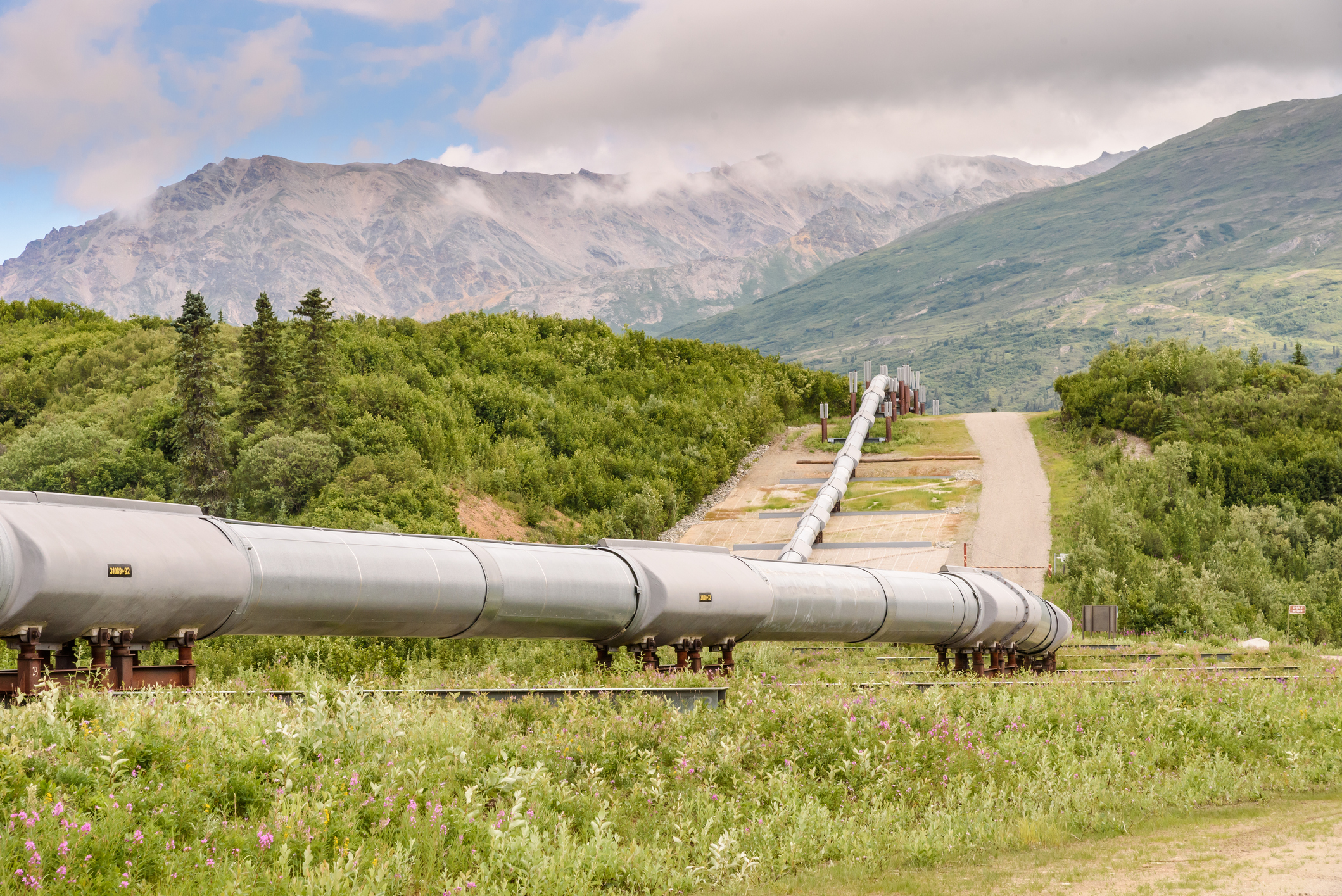
In early July, the premiers of the Canadian Provinces of Alberta and Ontario proposed a massive new West-East oil pipeline that would transport up to 500,000 barrels per day of oil across the country for refineries to process into gasoline and other fuels.
The pipeline, known as the Northern Shield Energy Corridor, would end in Sarnio, Ontario, just across the border from Michigan, north of Detroit, and help reduce Canada’s reliance on foreign markets during a time of increased hostility from the Trump Administration. The pipeline would add redundancy to existing fossil fuel infrastructure and strengthen Canadian national security, according to a press release.
But indigenous groups and environmentalists oppose the project because of its potential impact on land, water, and the climate, with the wildfires blazing across Canada an example of how global warming is already causing harm.
In announcing the proposed pipeline, Alberta Premiere Danielle Smith told reporters that: “We’re launching the greatest expansion of oil and gas infrastructure and production in decades.”
While fossil fuel production may have picked up political steam, the pipeline remains in the proposal stage with a company called Pembina Pipeline the only private-sector partner and no oil producers committed yet to shipping on the line. Experts are skeptical that the pipeline would be economically viable and that the Ontario refineries could handle the additional load.
Stewart Prest, a political scientist at the University of British Columbia, said no private business case currently exists for the pipeline, “hence the project being government led.”
“The pipeline serves political purposes as much as economic one, as a symbol of nation-building in general, and links between two conservatively-governed provinces in particular,” said Prest.
Prest said it’s clear that U.S. policies under Trump are a huge driver in this proposal.
“For much of the last 40 years, Canada has sought to improve economic ties with the United States, including in particular in the energy sector,” said Prest. “The spectre of endless tariffs and trade wars, however, has turned that thinking on its head in the last 18 months. Most Canadians now are supportive of policies that reduce the country's dependence on the U.S. in favor of greater independence to operate without the threat of U.S. interference.”
Hadrian Mertins-Kirkwood, a political economist at the Canadian Centre for Policy Alternatives, told PressProgress that the pipeline should not be built because of its impact on the global climate. “We should not be, and cannot afford to be — in light of the orange skies above us — doubling down on oil and gas production.”
A similar west-east pipeline project known as Energy East was abandoned in 2017 by TransCanada, the company behind the Keystone XL pipeline, after years of regulatory challenges and political and environmental opposition. At the time, Bill McKibben, a highly regarded environmental activist and author said, “the climate math is sadly simple — the carbon contained in Alberta’s tar sands must stay there.”
The Alberta-Ontario announcement came only days after Smith proposed a pipeline route for another Alberta pipeline, this one to run west to the British Columbia coast, that could transport up to one million barrels of crude oil per day. That pipeline was at the heart of a sweeping agreement that Canadian Prime Minister Mark Carney signed with the government of Alberta, home to the country’s vast tar sands oil reserves, in late 2025 laying the groundwork for a new pipeline to British Columbia’s northern coast.
While that agreement doesn’t mention the U.S. explicitly, Carney said at the time of its signing that the fact that 95 percent of Canada’s energy exports go to the U.S., while once a strength, “is now a weakness.” Carney called this new geopolitical reality “a rupture, not a transition,” and said it means that Canada’s “economic strategy needs to change dramatically and rapidly.”
Ontario’s Minister of Energy Stephen Lecce echoed Carney’s sentiments with the announcement of the new pipeline running east.
“50% of oil imports into Ontario run through a pipeline that cuts through the U.S,” Lecce posted on social media on July 6. “It is clear we need a sovereign pipeline route that connects Alberta crude oil to Sarnia—the country’s largest refinery and petrochemical hub.”
On July 20, the Trump administration imposed 50 percent tariffs on Canadian exports, but crude oil was exempted.
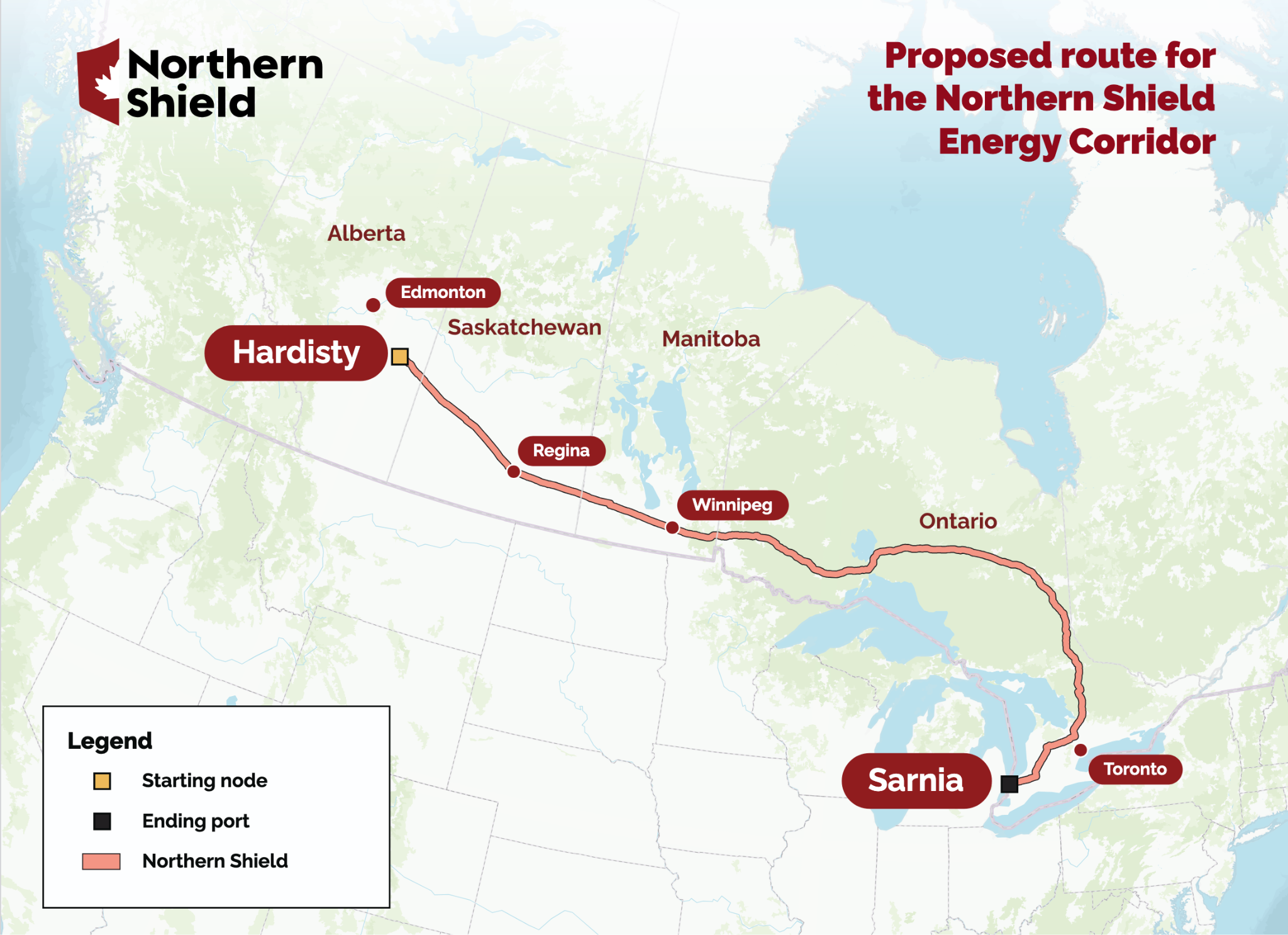
Image courtesy of the Government of Ontario, https://www.ontario.ca/files/2026-06/moi-northern-shield-energy-corridor-en-2026-06-30.pdf
Heather Exner-Pirot, director of energy, natural resources and environment at the Macdonald-Laurier Institute think tank, said the flurry of proposed pipelines in Canada wouldn’t have happened without Trump’s return to office.
“The idea of the Northern Shield Energy Corridor was dead as a doornail until Trump was elected,” said Exner-Pirot. “No one believed in it anymore, then it went from being off the radar to being submitted.”
Exner-Pirot added that she doubts the pipeline will get built, as it makes little economic sense. But she said another reason the government wants to study the feasibility of constructing it: Michigan’s Governor has been trying for several years to shut down Enbridge’s Line 5, which feeds Canadian oil to Sarnia via the United States. Currently, Alberta’s oil travels through the U.S. to reach eastern Canadian refineries in Sarnia. The Northern Shield would avoid this detour into increasingly hostile territory.
The threat of shutting down the Line 5 pipeline is less severe than it was a few years ago. Enbridge is currently building a new 41-mile stretch of Line 5 around the Bad River Band of Lake Superior Chippewa reservation since the tribe sued in 2019 to shut down the pipeline on its lands. Trump supports the Line 5 pipeline and recently issued a presidential permit authorizing the transport of crude oil and petroleum products across the U.S.-Canada border. However, the Supreme Court recently determined that the battle to keep a section of the Line 5 pipeline open belongs in Michigan courts and not federal court, and the possibility of an injunction or some other disruption still looms.
Daniel Béland, a political science professor at McGill University in Montreal, said the pipeline proposal is consistent with Carney’s push to reduce Canada’s dependence on the U.S. in the challenging and uncertain context of Trump’s second term.
“It also aligns with the perceived economic interests of Ontario and Alberta, Canada’s largest and second largest economies,” said Béland.
Béland said that opposition from environmental and indigenous groups as well as from some left-leaning parties present obstacles along with the cost of building such a long pipeline. “Only time will tell whether this proposal will ever materialize beyond the high profile political announcement we saw earlier this month,” Béland said. “Some pieces of the puzzle are obviously still missing at this early stage.”
The Anishinabek Nation, the oldest political organization in Ontario, Canada, representing 39 member First Nations and approximately 70,000 citizens, released a statement saying the Northern Shield announcement “blindsided First Nations.”
“This project represents a significant threat to our land, water, and future generations,” said Linda Debassige, Anishinabek Nation Grand Council Chief. “Major infrastructure projects that cross First Nations’ traditional territory must include meaningful engagement, consent, and respect for all First Nations along the project corridors.”
The feasibility study, which is expected to be completed by year’s end, will lay out the economic picture more clearly. Ontario Premier Doug Ford said that if the private sector is hesitant to invest, Ontario, like Alberta and the Canadian governments, will pour taxpayer money into the project.
If the pipeline gets built, there is room to expand its capacity to 800,000 barrels per day. And Ford said he envisions the pipeline possibly extending all the way to a refining facility along the Atlantic coast in New Brunswick, where oil could be exported to European markets.