Hawai’i considers tsunami of natural gas with first LNG terminal

Hawai’i has one of the most ambitious clean energy goals in the country, aiming for 100 percent renewable electricity by 2045. But the state today relies on oil for about 61 percent of its electricity generation, the highest of any state.
Clean energy advocates want the state to reduce its reliance on oil and are pushing for solar and wind. But a Japanese-based energy firm, JERA Americas, is proposing to move away from climate-friendly solutions with the proposed construction of Hawaii's first liquefied natural gas (LNG) import terminal to help meet rising power demand. Local environmental groups are concerned about turning to natural gas to provide electricity, especially in a state where renewables like solar and wind are abundant.
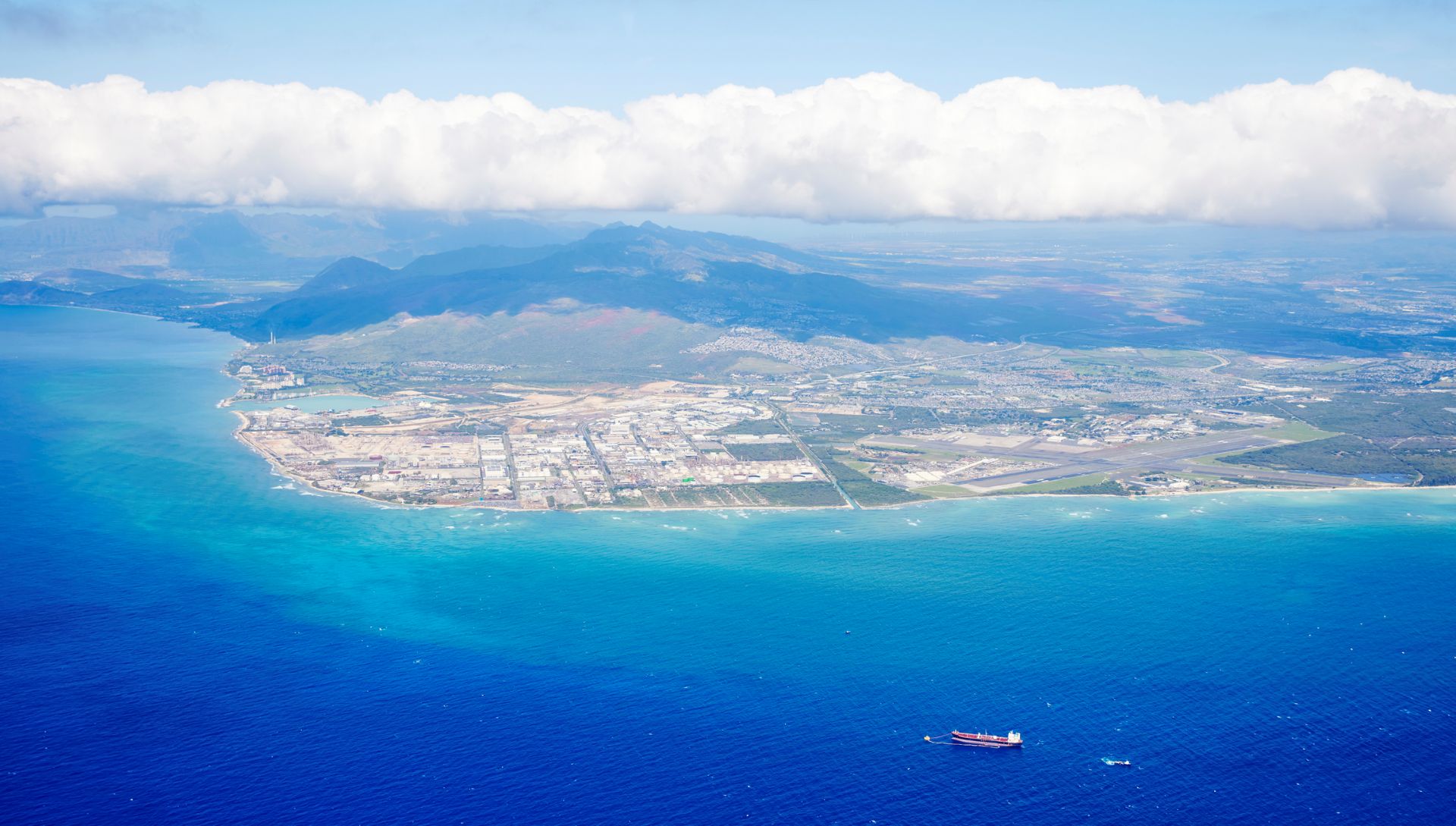
JERA Americas recently proposed a $2 billion offshore LNG import terminal called the Longboard LNG Project along with a 500-megawatt natural gas power plant on O’ahu. The project could provide roughly one-third of Oahu’s electricity.
The company argues that replacing oil with LNG would lower generation costs while providing reliable power. “It does come out to around a 20 percent savings on the generation side of power on Oahu,” said Erik Montague, JERA vice president.
JERA is the world’s biggest buyer and user of liquefied natural gas. Isaac Moriwake, a managing attorney for Earthjustice, said he heard that the company has been looking for opportunities to expand its LNG business throughout the Pacific.
But this doesn’t make sense in Hawai’i, Moriwake said, because the LNG project directly conflicts with the state’s renewable energy goals. “Numerous studies, including the utility’s own planning analysis, have shown that Hawai’i can get to 100 percent renewable before 2045,” said Moriwake.
The problem is cost and the logistical difficulty of building solar and wind energy projects on Hawai’i. The islands currently have the highest electricity costs in the United States. Residential rates averaged 41 cents per kilowatt-hour (kWh), more than double the national average and about three times higher than the cheapest states like Idaho and North Dakota.
Although sunshine is famously abundant on the islands, solar power today only provides about 24 percent of the electricity in Hawaii.
Michael J. Roberts, an economics professor at the University of Hawai’i, said the state pays prices for solar that are far too high, nearly double what is typical in the contiguous United States, in part because of a challenging review process. “The details of our process make it especially costly and risky for developers to build solar and wind projects here,” he said.
Like many other areas across the U.S., demand for electricity is growing rapidly in Hawai’i. But unlike in many other states, this growth is not due to a spike created by artificial intelligence data centers. Instead, increased electrification of transportation and industries are driving the growth.
Wayne Chung Tanaka, executive director of Sierra Club Hawai’i, said JERA’s proposal would undermine the state’s goal of transitioning to 100 percent renewable energy by 2045. He said the economics of LNG would require state utilities to buy and burn about a million tons of the fuel per year. “That means no matter how much cheap, clean, reliable, and local renewable energy we develop, we still have to pay for the same amount of LNG, disincentivizing renewable build-out,” Tanaka said.
State Rep. Scot Matayoshi, the Democratic chair of the state House Consumer Protection and Commerce Committee, said he hopes the LNG project could lower energy costs, but that lawmakers need to see JERA’s full proposal before drawing conclusions.
“Right now, it’s just kind of pie in the sky,” Matayoshi said. “They’re telling us all of the good parts and we need to make sure that all the bad parts get into the sunlight too.”
According to JERA, the Longboard LNG project would receive the LNG on a special ship called a “Floating Storage and Regasification Unit,” moored about two miles offshore. The gas will then travel onshore through a three-mile sub-sea pipeline and enter the Hawai’i Gas pipeline system and be delivered to power plants.
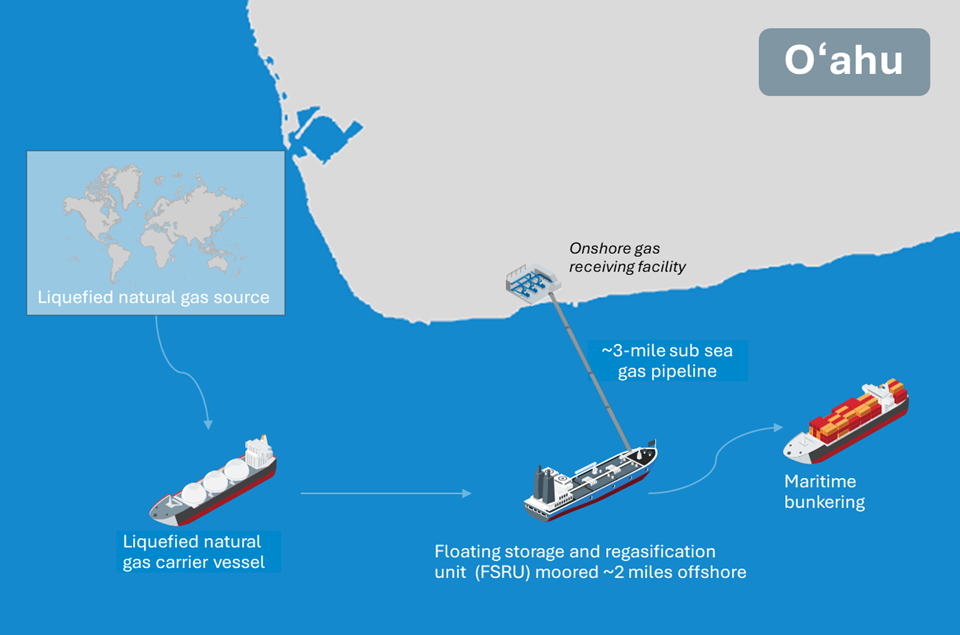
JERA plans to submit its formal application in December with the intention of beginning energy generation by 2030. The company held two open houses on Oʻahu in August where the public could express views and concerns. The Federal Energy Regulatory Commission (FERC) is also accepting public comments through an online comment system.
Henry Curtis, executive director of Life of the Land, among Hawaiʻi’s oldest environmental organizations, was one of the first to submit a public comment. He urged federal regulators to look beyond simply the environmental impacts related to the offshore infrastructure that makes up a relatively small part of the project and examine the broader impacts to the climate and environment of burning natural gas.
A March 2026 paper called “The Clean Energy Future Hawaiʻi Can Actually Build” by Michael Barnard of TFIE (The Future Is Electric) Strategy, found that as the state’s most populous island (O’ahu) transitions to more efficient electric transportation and industrial systems, renewable goals will become far more attainable.
Solar panels “are bought once, operated for years, and paired with very low marginal cost electricity,” Barnard wrote. “At this point, the better framing is not that clean energy has become viable. It is that imported fuel dependence is becoming the more expensive option.”
John Kawamoto, a former legislative analyst and environmental advocate, wrote in the Honolulu Civil Beat that the Hawai’i LNG project would be a “billion-dollar mistake.” “Supporters say LNG could lower electricity costs. But a closer look at the numbers suggests the opposite. LNG risks locking Hawaiʻi into higher costs for decades.”