War sent global fuel costs soaring, along with profits for major refining companies


Military strikes on refineries in the Middle East as part of the U.S. and Israel’s war with Iran, coupled with Ukrainian attacks on Russian oil refineries, have pushed prices for refined fuels to an all-time high. Diesel, for example, reached a record $6.53 per gallon on Sept. 21, the highest in 30 years.
That has meant sky-high profits for oil and gas refiners, who ramped up their facilities to take advantage of the soaring prices. High fuel prices during a period of global upheaval have been tough for consumers, farmers, and truckers, but have largely benefitted the world’s largest energy companies.
“I prefer the world of disruption to the peaceful world,” Patrick Pouyanné, chief executive of TotalEnergies, said during an October energy conference in London. “There are more opportunities, but you need to have the assets.”
Diesel costs have been particularly devastating for shippers and farmers, who buy huge amounts to fuel trucks and heavy equipment. The cost of fuel also helped drive U.S. inflation over the summer, with 3.4-percent increases in the consumer price index in both July and August, according to PBS.
U.S. Bank reported that shipping costs from July through September spiked by more than 32 percent compared to the same time last year, with demand for products remaining flat or declining. Bob Costello, senior vice president and chief economist at the American Trucking Associations, said that “shippers are spending substantially more to move essentially the same amount of freight.”
High prices at the pump have even led to complaints from President Donald Trump, who typically champions the oil industry. In August, after companies like ExxonMobil and Chevron had reported making billions more in profits, Trump told reporters the two companies “were making too much money based on a shortage.”
Trump may be echoing most consumers’ views, but the nature of a global energy market driven by supply and demand means that companies will always sell to the highest bidder. If an energy company decided to sell diesel at a below-market price, another trader, known as an arbitrager, would simply buy that diesel and sell at higher prices, reaping the profit for themselves, explained Robert Kaufmann, an expert on the oil and gas industry and professor at Boston University.
“I had a friend who was an arbitrager,” Kaufmann said. “They spend all day looking for a way to squeeze a penny from a trade.”
This year’s war-driven fuel bonanza has been particularly strong for companies that specialize in refining, whose profit growth through the summer months outpaced the financial success of more production-focused companies.
Marathon Petroleum, the U.S.’s largest refining company, is expected to report a more than 750 percent increase in earnings per share compared to the same period last year. Valero, another major U.S. refiner, reported third quarter profits of $6.8 billion, compared to $1.1 billion in the third quarter of 2025. Phillips 66 told investors that its net income leaped to $5.62 billion from $133 million the previous year.
These three refiners produced an average return of more than 52 percent from July through September, compared to 13 percent for production-focused companies, according to a recent analysis in Forbes.
The U.S.'s refinery fleet has been running at nearly full tilt – operating at 95 percent capacity, the highest since 1998, according to the Energy Information Administration (EIA). Fully integrated oil and gas companies that produce, transport, and refine oil and gas have also seen their refining divisions propel their profit margins to recent heights.
On Oct. 30, Chevron reported $9.9 billion in profit from July through September, triple its profit from the same period the previous year. Profits from its U.S. refining division increased to $3.59 billion from $638 million in third quarter 2025.
ExxonMobil more than doubled its profit during the most recent quarter to $15.4 billion, compared to $7.5 billion during the same period last year. The company plans to distribute $4.3 billion in dividends to its shareholders, along with approximately $5.1 billion in stock buybacks.
The cost of crude oil makes up the biggest share of what consumers pay for fuels like gasoline and diesel, according to the EIA. The price of Brent crude, used as a global benchmark, has remained above $100 per barrel for most of September and October, compared to the $60-70 range before the Iran war started. The cost to physically ship crude oil has also swelled this year, now adding as much as $40 per barrel of oil actually delivered to a refinery.
High crude costs could in theory cut into an energy company’s profits, but a loss of refining capacity in the Middle East and Russia has kept global prices high for refined fuels like gasoline, diesel; heating oil, and jet fuel have also remained elevated. One common industry benchmark is the 3-2-1 crack spread, a measurement of the profit a refiner could make from converting three barrels of crude oil into two barrels of gasoline and one barrel of distillate (diesel or heating oil). In September, this margin reached $71 per barrel, 226 percent above the $32 per barrel in September 2025.
High industry profits are driven by a gap that has widened this year between the price of a barrel of crude oil and the price of a barrel of a refined product, such as gasoline, diesel, or jet fuel. This gap is known as a “crack spread” because refineries separate, or “crack,” crude oil into other fuels, lubricants, and chemical ingredients.
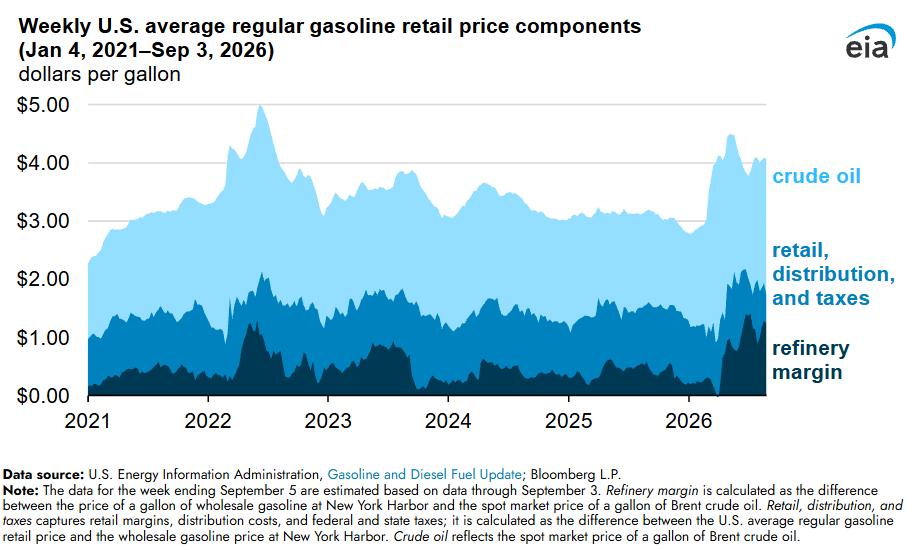
In early September, the diesel crack spread – the difference between the price of a barrel of crude oil and the price of a barrel of diesel –reached a record high of $105.66 per barrel, with multiple days in a row over $100 per barrel, according to trade publication RBN Energy.
Overall, the U.S. exports more liquid fuels like gasoline and diesel than it imports. American consumers generally pay close to global wholesale prices for these fuels, said Timothy Fitzgerald, an energy economist and associate professor at the University of Tennessee, Knoxville. “Being a net exporter does affect the balance of payments around fuels and makes the country as a whole better off relative to a case in which we are a net importer,” he said.
However, when the global price of fuel rises, prices also rise for Americans. The benefits of being a net fuel exporter are “hard to perceive for most consumers, who simply buy fuels at the prevailing prices, whether imported or not,” Fitzgerald said.
Lead photo: ExxonMobil's Baytown Refinery near Houston. Photo by Garth Lenz / Flight SouthWings.