In the wake of a petrochemical boom, companies now plan layoffs for thousands of workers

A boom in plastics and petrochemical manufacturing driven by cheap U.S. natural gas has given way to rounds of layoffs over the last two years because of overbuilding, competition from China, and the advance of technology that replaces human workers.
Chemical companies that are major U.S. plastics manufacturers – including Dow, Westlake, and Eastman – have said they are trimming their workforces by thousands of employees this year, according to company announcements and filings with state workforce agencies.
All three of these petrochemical companies are laying off workers even as profits are up. So executives and stockholders are doing well while they terminate their workers, in part because technology allows companies to produce more chemicals with fewer employees.
Dow, for example, has planned layoffs for at least 6,000 workers over the last year, while raking in more profits selling plastics and chemicals this year than last. The company reported $12.1 billion in net sales from April through June, 20 percent more than the second quarter of 2025. Dow stock is 22 percent higher today than a year ago.
The global petrochemical industry, particularly plastics manufacturers, has “been in a state of flux” mainly due to the “overbuild of facilities resulting in severely oversupplied conditions,” said Trey Cowan, an analyst with the Institute for Energy Economics and Financial Analysis.
The industry is shedding jobs even as prices for plastic products are up this year compared to the previous year. For example, the price of polyethylene, a key plastic ingredient, is 17 percent higher as of Sept. 21 compared to the previous year, mainly because of disruptions in global petrochemical supplies caused by the U.S.’s war with Iran.
The recent wave of layoffs is a hangover following about a decade of excessive petrochemical industry expansion, driven in part by vast volumes of relatively cheap ethane unlocked by horizontal drilling and hydraulic fracturing. The U.S. currently has about 35 ethane “cracker” facilities that break ethane, which often comes out of the ground with oil and natural gas, into the basic building blocks of plastics and other chemicals, according to federal data cited by Moms Clean Air Force.
Over the past decade, companies built three massive new ethane cracker plants, two in Texas and one in Pennsylvania, as well as expanding and bringing back online an idled plant in Louisiana. Companies also built one new plastics plant and completed at least 61 expansion projects at existing ethane crackers, propylene plants, and plastics plants, according to Oil & Gas Watch.
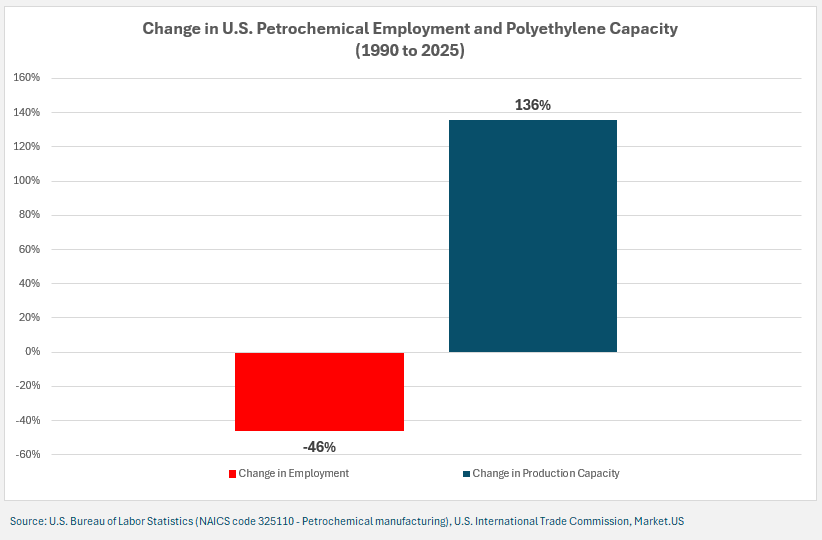
Over the long term, companies are also finding ways to produce plastics and other chemicals with fewer workers than they did decades ago. For example, the petrochemical industry employed 46 percent fewer workers in 2025 than in 1990, while the capacity of U.S. facilities that make polyethylene, one of the most widely used types of plastics, has increased 136 percent, according to federal data Cowan shared.
The number of people employed in plastics and rubber manufacturing reached a high point in February 2000, when nearly 960,000 people worked in the industry, according to the Bureau of Labor Statistics. As of August 2026, that number had dropped to about 690,000, a 28-percent decrease. Petrochemical industry workers also dropped from 985,000 employees to 898,000 during the same period, an approximately 9-percent decrease.
A wave of layoffs among U.S. chemical manufacturers over the last two years follows a global slowdown largely influenced by demand and competition from China. The country’s demand for plastic ingredients has diminished because of the country’s cooling economy and a glut of new Chinese facilities that make the same products, Cowan said.
“Whenever you talk about oil, gas, and petrochemicals, China tends to be the swing consumer,” Cowan said. “That is definitely the case for polyethylene.”
In January, Dow Chemical announced it would lay off 4,500 employees, about 13 percent of its global workforce. This followed the company’s announcement of a $1 billion “savings plan” in January 2025 that involved 1,500 layoffs, with the company updating its savings goal to $6 billion in April 2025.
Dow is the U.S.’s largest chemical manufacturer, with production sites around the world but heavily concentrated on the U.S. Gulf Coast. Its largest manufacturing site is in Freeport, Texas, southeast of Houston, where the company began operating a new ethane cracker in 2017. A company spokesperson told local newspaper The Facts in June that the layoffs would affect Freeport but did not say how many employees there would lose their jobs.
Meanwhile, Dow is making more money selling plastics and chemicals. Sales of its products were up 20 percent compared to a year ago, led by increases in prices for plastics around the world. “Our actions to become a leaner, more competitive company position Dow well to continue winning with our customers while delivering enhanced long-term shareholder value,” Dow CEO Karen Carter said in a July 23 statement.
“Shareholder value” is the goal for the company – not maximum employment. Dow is also far from the only chemical manufacturer announcing layoff plans over the past two years.
In December 2025, Westlake Chemicals announced it was closing a plant in Mississippi that made polyvinyl chloride, or PVC. The company also said it would close plants in Louisiana that made vinyl chloride, chlor-alkali, and styrene.
“The overcapacity in the global markets created downward pressure on the sales price for our exports, leading to unprofitable conditions at some of our higher-cost manufacturing sites,” Westlake CEO Jean-Marc Gilson told analysts at the time.
Other companies that make plastic products are also downsizing. They include INEOS Styrolution, which in June announced it would close a facility southwest of Chicago that makes polystyrene, used in foams and other packaging materials. The company’s plans involve laying off 94 workers, according to the Peoria Journal Star.
"This was a deeply difficult decision, made after a thorough evaluation of market conditions, ongoing industry oversupply, persistent margin pressures, and the site's cost structure," an INEOS spokesperson told the outlet.
In Alabama, German chemical company BASF is laying off 80 workers at a plant in Washington County, north of Mobile, by Sept. 30. The company had said in May that it would stop operating multiple production lines at the facility that makes chemicals for the plastics and automotive industries, according to AlabamaGermany Partnership, a statewide nonprofit.
Also in Alabama, Philadelphia-based FMC Corp plans to lay off 41 employees at its Mobile County site by the end of October, according to AL.com. The company produces pesticides and herbicides for the agricultural industry.