New York denies ‘zombie’ pipeline again as Trump Admin threatens to revoke authority to block polluting projects

In late January, the New York Department of Environmental Conservation filed its opposition to the Constitution Pipeline, which would run 124 miles from the Marcellus shale gas fields in Pennsylvania to Albany, New York, where the gas would be distributed mainly to power generators across New England.
In its filing with the U.S. Federal Energy Regulatory Commission (FERC), the agency said it opposed Constitution’s request for a water quality permit because Williams, the pipeline’s Oklahoma-based developer, is attempting to "bypass critical environmental reviews and undercut New York State’s regulatory authority."
Williams resuscitated the long-contested Constitution Pipeline in late 2025 a decade after New York regulators first denied the pipeline the water quality permit. After years of legal and regulatory battles, Williams canceled the pipeline in 2020.
Then came the reelection of President Donald Trump. Shortly after coming into office, Trump said the pipeline would greatly bring down energy costs in the region and that the developer had almost all of the permits necessary to construct the pipeline.
Last May, the Trump Administration allowed construction on a major offshore wind project off Long Island to proceed, asserting that the move was part of a deal in which New York’s Democratic Gov. Kathy Hochul agreed to reverse the state’s long-standing opposition to natural gas pipelines. Not long after, New York regulators issued a Clean Water Act Section 401 permit for the Northeast Supply Enhancement pipeline, a shorter pipeline that mostly runs underwater off the coastlines of New Jersey and New York. Such permits are meant to ensure that pipeline projects that cross state lines do not lead to violations of water quality standards.
However, in January 2026, Hochul made her opposition to the Constitution Pipeline clear, stating that while she’s been open to natural gas as part of an all-of-the-above energy strategy, she’s “been clear that any projects must be reviewed impartially by state agencies and comply with all applicable laws…I will fight any attempt to circumvent our state’s authority or undermine our clean water laws.”
The state’s opposition to the project predated Hochul’s time in office. In 2016, then-Gov. Andrew Cuomo directed the state’s conservation department to deny all Section 401 water quality certifications for fossil fuel pipelines in New York, effectively blocking the Constitution Pipeline.
When Williams challenged the denial, the Second Circuit Court of Appeals ruled in 2017 that the state acted within its authority. The U.S. Supreme Court allowed the court’s decision to stand in 2018. Williams then asked FERC to waive the necessary permit, which FERC did in 2019. Several environmental groups opposed to the pipeline filed two lawsuits in the Second Circuit, one challenging FERC’s waiver order and one challenging FERC’s approval of the pipeline. Facing these legal challenges Williams abandoned the project and let its certificate expire at the end of 2020.
The company’s revival of the Constitution Pipeline comes as the EPA considers a proposed rule to narrow the scope of Section 401 of the Clean Water Act, which states have used for decades to restrict energy projects that could discharge pollutants into nearby waterways. Under the proposed plan, states and tribes could only address pollution from "point source" discharges into a waterway rather than considering the overall impact of a project including things like land use, wetlands impact, and air pollution.
In January, a hundred organizations from across the country submitted comments to EPA that urged it to abandon the proposed rule, saying it would make it harder for states and tribes to protect local water quality threatened by large projects, including data centers, hydropower dams, and new highways.
Roger Downs, conservation director of the Sierra Club Atlantic Chapter, said New York has a long, troubling history of pipelines and water quality violations. In 1996, the Iroquois Pipeline Company pled guilty to hundreds of Clean Water Act violations during the construction of a 375-mile-long gas pipeline across the state. These violations mainly centered on allowing erosion and the discharge of sediment into streams and rivers. A decade later, the construction of the Millennium Pipeline resulted in the same catastrophic erosion events and negligent destruction of aquatic habitats.
“So when the Williams pipeline company, a notorious environmental polluter in its own right, announced plans to build the Constitution Pipeline for the first time in 2014, New York’s Department of Environmental Conservation must have felt a horrible sense of déja vu,” Downs said.
Downs said there is every indication that New York’s Department of Environmental Conservation will continue to defend its denial of the Section 401 permit.
“Despite the Hochul administration’s abdication on the Northeast Supply Enhancement pipeline, said Downs.
In an August 2025 op-ed in The Boston Globe, EPA Administrator Lee Zeldin said “New England should come together to support American energy infrastructure, including the Constitution Pipeline project, to provide much-needed grid stability, create jobs, and reduce energy prices across the region for American families who have suffered long enough.”
Gillian Giannetti, a senior attorney with the Natural Resources Defense Council, said Zeldin’s defense of the pipeline is not only factually incorrect, but incorrect in terms of policy and as to what will best strengthen and reinforce New England’s energy system.
“There’s definitely an increased demand for electricity nationwide, and New England has historically been more dependent on natural gas than other regions,” Giannetti said. “However, that doesn’t mean the solution is to build the Constitution Pipeline.”
For starters, the pipeline wouldn’t even bring much gas to New England, as it terminates in New York and connects to existing gas pipelines that are already operating at or near capacity, she said. Also, adding natural gas to the region where many states have clean energy pledges and laws goes against existing policies.
“Additionally, when you’re looking to increase the stability and strength of the grid, you want variety even more than redundancy,” Giannetti said. “The ability to pull power from a variety of energy sources allows flexibility to shift in high-intensity weather situations. Just having more gas, if the gas goes out, doesn’t do anything to ensure the stability of keeping power on in a snowstorm.”
Giannetti said that the administration is trying to bring back a “zombie pipeline” that was an environmental disaster when first approved. She said that despite not having all necessary permits back then, developers started tree-felling in Pennsylvania, where they destroyed a maple farm.
“They’ve been hostile to landowners and community members,” she said. “It was a bad project in 2013 and it’s a bad project now.”
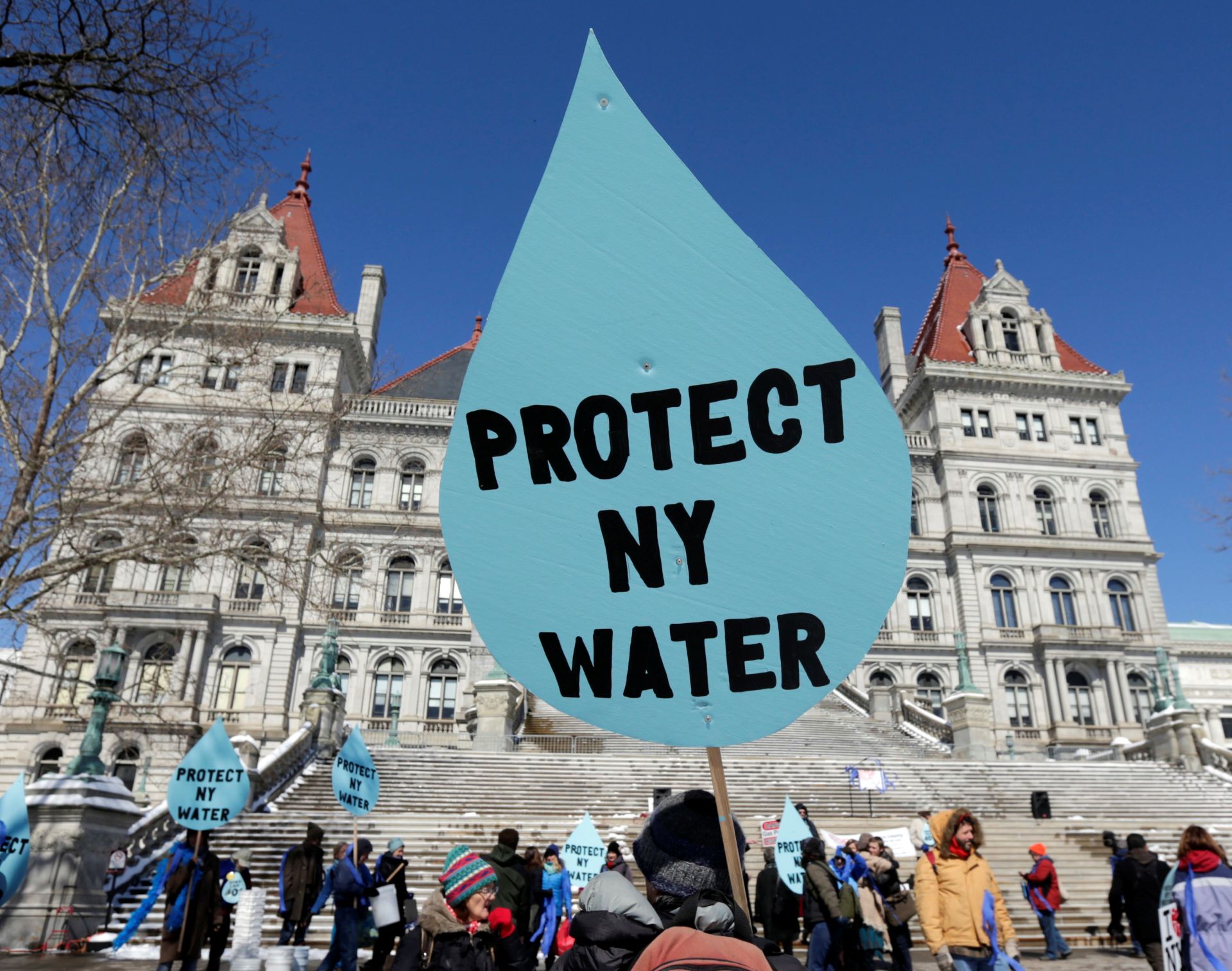
Lead photo: A rally opposing the Constitution Pipeline outside the New York state Capitol on April 5, 2016, in Albany. (AP Photo/Mike Groll)