Data centers raced to beat Virginia’s new clean air law

Virginia lawmakers passed a new law in April to curb air pollution from new and expanding data centers with diesel generators by requiring the strongest possible standards for nitrogen oxides, carbon monoxide, and soot.
The new requirements kicked in on July 1. But data center developers saw the deadline coming and raced to beat it, with 19 applications filed this spring that were submitted in time to take advantage of the older, dirtier, and cheaper standards. Nearly two thirds of the applications for diesel generators, including by Amazon, Google, and Vantage, flew in just before the deadline in the final two weeks of June, according to public records obtained through a Freedom of Information Act request.
“Filing an application right before a more health-protective standard takes effect shows that these data centers do not intend to be good neighbors,” said Dr. Mary Finley-Brook, a professor at the University of Richmond who also leads a coalition called Data Center Defiance that is working to support communities fighting a wave of data centers in Central Virginia. “It shows they’re not thinking about the community, but rather, what’s easiest for them and their profit margin.”
The 19 applications propose adding 2.8 gigawatts of new generation capacity using the older, dirtier standards. That’s almost as much as the electricity needed to power all of the homes and businesses served by Virginia’s biggest utility, Dominion Energy.
The applications for the data center backup generators also propose emitting up to 671 tons of smog-forming nitrogen oxides, as well as 374 tons of carbon monoxide, and about 40 tons of particulate matter, or soot. That’s about what could be emitted from a large new gas-fired power plant.
If these projects had met the new standards, their nitrogen oxide pollution could have been reduced by more than half and carbon monoxide emissions by 90 percent.
Seven of the applications were for new data center campuses, including Google’s Project Raspberry in Botetourt County and Project Skye in Chesterfield County, and AVAIO Digital’s massive Project Hercules in Appomattox County. The proposed generators at new campuses could add nearly 1.8 gigawatts of new generating capacity, enough to power 1.5 million homes.
On June 30, Google applied for a new data center complex called Project Skye in Chesterfield County, southwest of Richmond, that has been strongly opposed by local residents because it could eventually include four massive buildings in a residential area.
But the air permit application for the project included just one data center building along with 21 diesel generators. The developers were seeking to use the old, weaker air pollution standards because they sent the application to the Virginia Department of Environmental Quality just one day before the deadline for the stronger, new standards. Nitrogen oxides emitted from the generators at the site, which would be near a middle school, could reach 53 pounds per hour, or as much pollution as from 304 medium heavy-duty diesel trucks idling at once. Generators for the other three buildings on the campus will need to meet the more stringent air standards, because they did not meet the July 1 deadline.
Developers of the largest new data center project, AVAIO’s ADP Appomattox Data Hub, also known as Project Hercules, on April 9 requested permits to install 280 generators with the capacity to produce up to 840 megawatts of electricity. The company made the request on April 9, the day after the new air pollution control law was signed by the governor. It could emit up to 96 tons of nitrogen oxides, along with 12 tons of carbon monoxide, and two tons of soot per year in Appomattox County, according to the permit application. Carbon monoxide and soot emissions could be significantly lower if the plant had to comply with the new standard.
Google on May 13 applied to build a controversial data center called Project Raspberry near Roanoke in Botetourt County. The permit application requests approval to install and operate 129 generators capable of producing 349 megawatts of power, along with 99 tons of nitrogen oxides, 21 tons of carbon monoxide, and seven tons of soot per year. Because the application was filed before July 1, the developers will be able to use the older, weaker air pollution control standards.
The project is already facing additional scrutiny because of concerns about its potential environmental impacts. The Virginia Department of Environmental Quality (VDEQ) has indicated that the project’s air permit will go through a public comment process.
Two other applications for brand new data center campuses – one in Louisa County, the other in Loudoun County – were submitted during the last week of June.
Overall, 12 of the 19 applications filed before the July 1 deadline were requests to expand and add new generators to existing or new data center buildings. Expansion projects ranged from installing 187 new generators at Vantage’s VA3 data center in Loudoun County, to just one or two new generators at other existing sites. The average in these applications was for 25 diesel generators seeking to use the old, dirty standards. Altogether, these generators could add another 980 megawatts of generating capacity – enough to power 817,000 homes – to data center campuses, according to the permit applications.
The Vantage VA3 data center is located across the road from another Vantage data center, called Vantage VA2. That facility has drawn public attention and outcry due to repeated pollution events and noise from its on-site natural gas turbines.
Although a 2024 state legislative report suggested that backup generators for data centers typically run at a small portion of their capacity – and therefore release much less pollution than they are permitted to emit – this could change because of increasing demand on the electricity grid.
Emergency orders from the US Department of Energy are also making it more likely that generators will run more and with permission to exceed their permit limits. At least six times this year, the Department of Energy issued authorizations to PJM, the nation’s regional transmission operator, authorizing them to direct data centers to run back-up generators to avoid grid instability. It has issued 46 other emergency orders, many of which aim at keeping inefficient coal power plants running to meet growing demand.
“They’ve been handing these emergency orders out like candy at Halloween,” said Julie Bolthouse, Director of Land Use at the Piedmont Environmental Council. She argues that regulators should instead be requiring data centers to use batteries to cover short term power outages and take other steps to reduce air pollution.
Another reason generators may run closer to their permit limits in the future could be because of the new clean air law itself. Generators that meet the old standards are limited to running during emergencies and testing under state law. But if they meet the new standards, they could run outside of emergency situations, potentially resulting in more emissions.
Because the new law left many air pollution concerns unaddressed, environmental advocates say they are planning to propose legislation to tighten up the rules during the next legislative session.
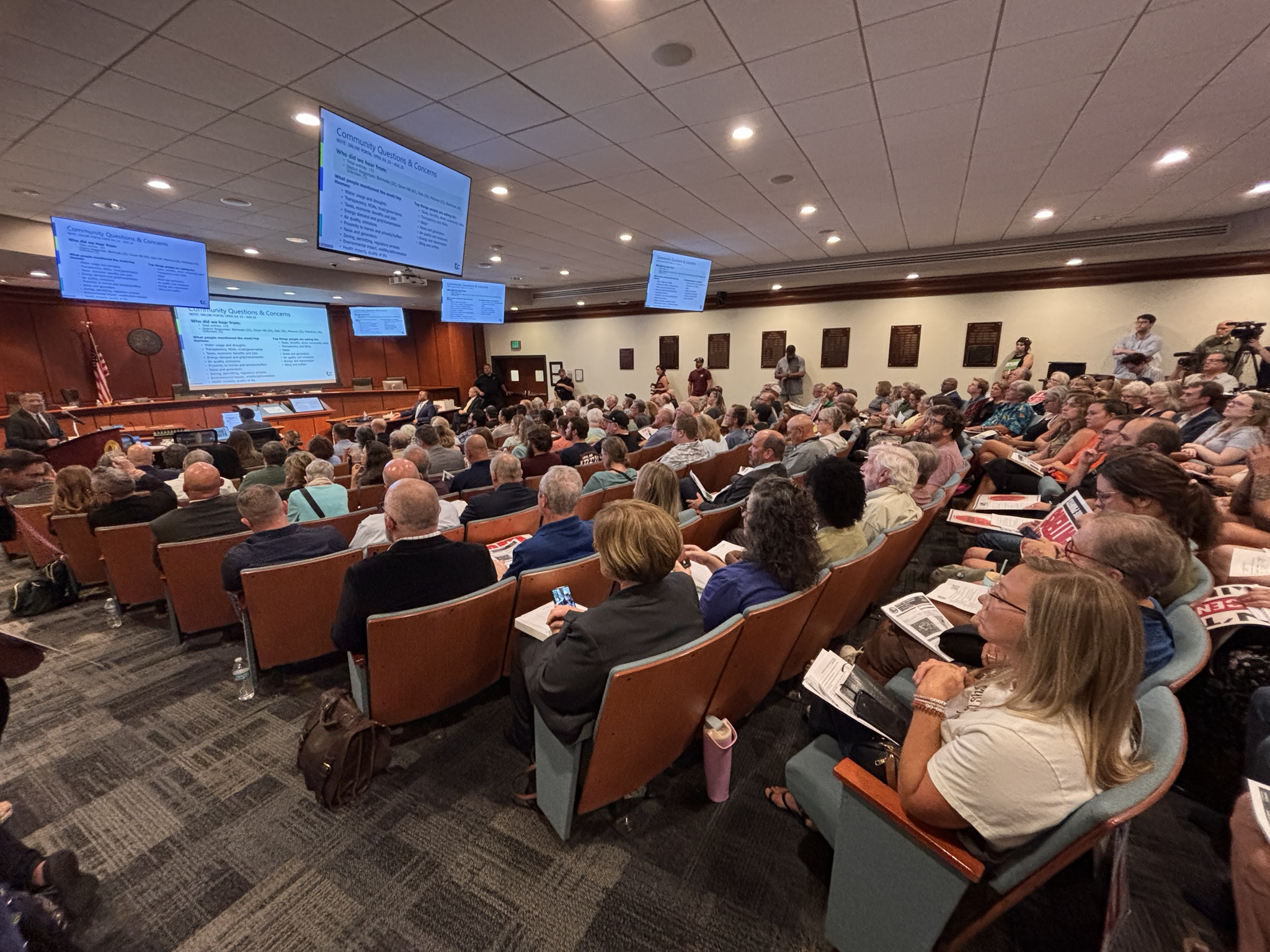
Lead photo: Concerned residents packed the room at a Chesterfield County Board of Supervisors meeting to hear about Google's proposed data centers on August 26, 2026. Photo credit: Beth Zizzamia.