
New LNG terminal expansion projects in Louisiana and Texas boosted by wars

_resized.jpg)
Over the last 14 months, liquefied natural gas (LNG) companies have proposed new expansion projects at seven gas export terminals along the Gulf Coast, encouraged in part by wars in the Middle East and Ukraine that have boosted the market for U.S. LNG shipments.
Three of the expanding terminals are in Louisiana, including southeast of New Orleans at the Plaquemines LNG terminal; and in Cameron, in southwest Louisiana, at the CP2 and Commonwealth LNG terminals, according to public records available in the Oil & Gas Watch database. Four expanding terminals are located in Texas, near Port Arthur, Brownsville, and Corpus Christi.
If built, these new expansions would increase by about 14 percent, or 75 million metric tons per year, the capacity of U.S. LNG export terminals that are operating, under construction, or previously proposed. The expansions and associated pipelines could also damage hundreds of acres of fragile coastal wetlands and release millions of tons of greenhouse gases, according to permit applications.
“These gas export facilities are a radical transformation of the Louisiana coast,” said Anne Rolfes, director of the Louisiana Bucket Brigade. “This coastal area, including our wetlands, protects south Louisiana from storms, a crucial buffer as hurricanes get more fierce. Now that protection is paved over, transformed into concrete so that an out-of-state corporation can make money.”
Developers of the LNG projects argue that the wars in Iran and Ukraine are contributing to increasing market demand overseas for U.S. LNG exports, and the new expansions of Gulf Coast export terminals would help meet that rising need.
“Recent disruptions to LNG exports through the Strait of Hormuz are increasing demand for LNG cargoes from outside the strait,” Venture Global, which is building the CP2 LNG expansion project near Cameron, Louisiana, said in its May 26, 2026, application to the Federal Energy Regulatory Commission.
Overall, nine LNG export terminals have been built across the U.S. over the last ten years. The industry’s rise was driven by the proliferation of new drilling techniques, including hydraulic fracturing and horizontal drilling, which dramatically expanded production of natural gas from shale rock formations.
The new expansions at seven LNG terminals, proposed since August 2025, would not be completed for several years. The largest expansions are proposed at the Port Arthur LNG Terminal in Port Arthur, Texas; the CP2 LNG Terminal in Cameron, Louisiana; and the Plaquemines LNG Terminal in Port Sulphur, Louisiana.
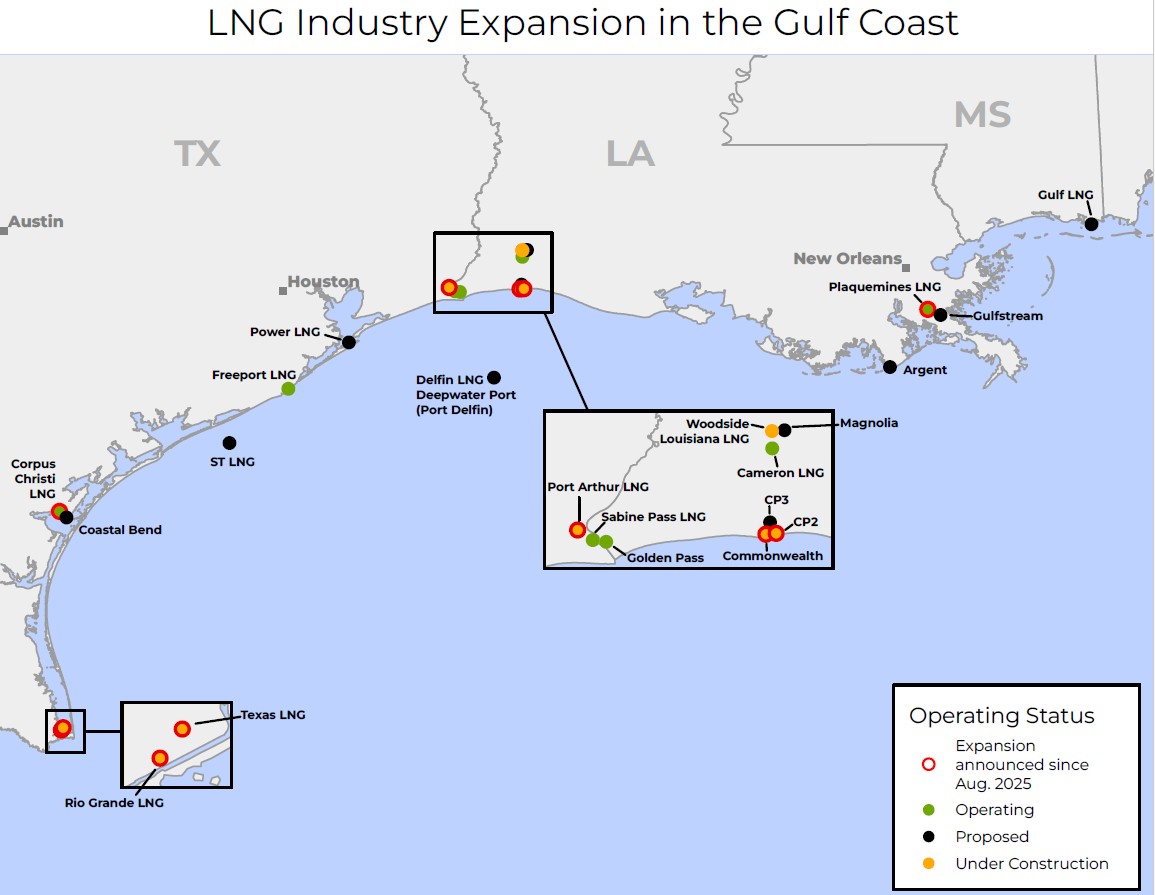
This new wave of expansions are on top of projects to build 24 new or expanded LNG terminals that were previously proposed, before August 2025, along the Gulf Coast, Alaska, and in other states, according to public records in the Oil & Gas Watch database.
The boom started in Louisiana, which has been an epicenter of the LNG industry. The first export of LNG from the U.S. came in 2016 from Cheniere Energy’s Sabine Pass Liquefaction Terminal located in Cameron Parish, in far southwestern Louisiana.
Since then, U.S. LNG exports have grown into a $44 billion annual industry that, within the next five years, has the potential to become the second largest net export from the U.S., behind only civilian aircrafts and parts, according to an estimate by S & P Global Energy.
As wars overseas continue to destabilize global energy markets, Wall Street investors are reportedly eager to fund U.S. LNG export opportunities that are perceived as more reliable and stable than LNG coming out of Russia or the Middle East.
One of the expansions is of the Venture Global CP2 LNG Terminal under construction about an hour south of Lake Charles in Cameron, on the Gulf Coast. The terminal, as originally proposed, would have had a processing capacity of 28 million metric tons of liquified natural gas per year.
But then in June 2026, Venture Global received permission to increase this terminal’s capacity by seven million metric tons per year. On top of that, Venture Global also submitted an application in May of 2026 seeking approval to increase the terminal’s export capacity by an additional 11.7 million metric tons per year.
The company’s Chief Executive Officer, Mike Sabel, said that Venture Global is positioning itself to become the largest exporter of LNG in the U.S. “We will build on the strong construction progress already underway and deliver reliable American LNG to customers around the world,” Sabel said in a press release.
But Breon Robinson, the Southwest Louisiana Organizer of Healthy Gulf, a nonprofit organization, said that the scale and the pace of the construction projects are threatening radical changes along the Gulf Coast.
“What’s especially concerning is the trajectory we’re seeing,” Robinson said. Regulators should “stop looking at these projects as isolated developments and start asking what the cumulative impact of continually expanding LNG infrastructure means for our communities, our environment, and Louisiana’s long-term future.”
The potential emissions of the expansions are significant. The CP2 expansion project alone could release more than 4.8 million tons of greenhouse gases per year, according to permit applications and public records. That would be the equivalent of the carbon dioxide from roughly one million cars and trucks driven for a year.
“Southwest Louisiana is already living with the health impacts, the traffic, and the loss of fishing grounds from the terminals we have, and families are being asked to absorb even more,” said James Hiatt, Executive Director of For a Better Bayou. “Regulators keep approving these expansions one piece at a time while the people of the Gulf Coast live with the whole thing.
Venture Global has also proposed a similar expansion at another LNG terminal: the Plaquemines LNG Terminal, on the west bank of the Mississippi River about 25 miles southeast of New Orleans.
As planned originally, the facility would have been capable of producing 24 million tons of liquefied natural gas per year. But Venture Global has since applied for various expansions that would almost triple this capacity to 66 million metric tons of LNG per year.
These expansions are not limited to Louisiana. Similar proposals are also being announced for LNG terminals in Texas. One example is the Port Arthur LNG Export Terminal in East Texas, which is already under construction and could process up to 27 million metric tons of LNG per year. But in September of 2026, Sempra announced plans to build an expansion of the terminal that would double the facility’s processing capacity, bringing it to a total of 54 million metric tons of LNG per year, according to permit documents.
Impacts from these projects extend beyond the projects themselves to associated infrastructure, including pipelines.
The Cloud Connector, a proposed 165-mile pipeline that would transport natural gas to the Plaquemines LNG Terminal, is expected to damage up to 1,428 acres of wetlands, according to public records. Despite these impacts, the public was only given 11 days to notice to submit public comments – instead of the normal 30-day public comment period – because of expedited “energy emergency” procedures enacted by the Trump Administration.
Wetlands are a shrinking resource in Louisiana. The Bayou State has lost close to 2,000 square miles of land since the 1930s, according to the Louisiana Coastal Protection and Restoration Authority.
Below is a list of the expansion projects proposed over the last 14 months, according to public records and company announcements.
Lead photo: Cheniere's Corpus Christi LNG terminal in Texas. Photo by Garth Lenz / Flight SouthWings.


