
The Keystone XL pipeline returns as ‘Keystone Light,’ but still faces heavy opposition


The hotly-contested Keystone XL oil pipeline project is back from the grave, but this time in a new form.
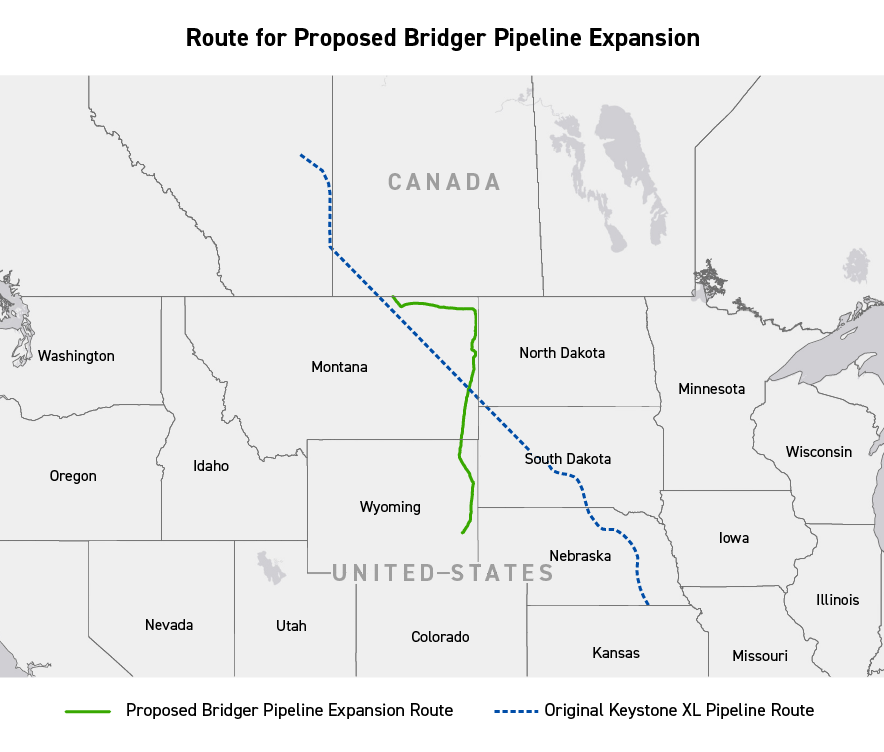
The Bridger Pipeline Expansion, sometimes called the “Keystone XL Light” Pipeline, is a proposed crude oil pipeline that would travel 647 miles through eastern Montana and Wyoming, along the border with North and South Dakota. In some ways, the project is similar to its predecessor, the Keystone XL Pipeline, which was declared dead in 2021 after an intense battle over its environmental impact.
But now with a permit approval by the Trump Administration on April 30, the project is making a comeback, albeit with key differences. Bridger is only about half the length of the Keystone XL Pipeline, which was 1,200 miles and could convey 830,000 barrels per day. Bridger’s developers say the new pipeline would transport less than that: 550,000 barrels per day. But the project’s design would allow for the potential to double throughput in the future, up to approximately 1.13 million barrels per day.
This project is being led by Bridger Pipeline Expansion, LLC, a different company from TC Energy, which originally owned the Keystone XL Pipeline before spinning off its assets into a new company, South Bow. South Bow is not involved in Bridger's proposal, but Reuters has reported that South Bow is separately exploring a revitalization of the Canadian section of Keystone XL, now being dubbed as the Prairie Connector, in response to the developments surrounding Bridger. The Prairie Connector would directly link to the Bridger Pipeline Expansion.
Krystal Two Bulls is the executive director of Honor the Earth, a grassroots organization in Montana that advocates for indigenous sovereignty and is fighting the pipeline. She said the Bridger Pipeline “is just the Keystone XL pipeline renamed and rebranded.”
The original Keystone XL Pipeline faced strong opposition from environmental and indigenous groups because of concerns about potential oil spills. The pipeline was planned to transport oil from the oil sands in Alberta Canada into the U.S. Midwest, where other pipelines could send the fuel to the Gulf Coast. The oil from the tar sands in Alberta is “derived from a sludgy, sticky deposit,” making it more difficult and costly to extract and damaging to the climate when it burns, according to the NRDC. EPA estimated that the operation of this pipeline over its 50-year life could release up to 1.37 billion tons of greenhouse gases. This is the equivalent of the emissions from about 300 million cars and trucks driven for a year.
The Obama Administration began the whiplash of back-and-forth decisions in 2015 when it vetoed a bill from Congress that would have authorized the pipeline project, arguing that the “the Keystone XL pipeline would not serve the national interest of the United States,” in part because it would contribute to climate change. Congress, controlled by Republicans at the time, disagreed with this assessment of the Democratic president and attempted to override the veto, but they ultimately fell short of reaching the required two-thirds majority.
President Donald Trump began his first term by signing a presidential memorandum that boasted his support for the project. The next step was receiving a “presidential permit,” which is required for pipelines that cross international borders of the United States. On March 24, 2017, Donald Trump signed this permit for the Keystone XL Pipeline, giving the project the green light.
Despite overcoming this hurdle, the project faced countless lawsuits, notably from environmental and indigenous communities. Mired in litigation, the pipeline experienced a stop and go pattern for construction. Because of these delays, only about 8 percent of the pipeline was built by the time President Joe Biden was elected, as reported by Reuters.
On Biden’s first day in office in 2021, he signed an executive order revoking the permit that Trump signed in 2017, explaining that “it would not be consistent with my administration’s economic and climate imperatives.” Seeing this as a bad sign for the project’s future, TC Energy announced that it was abandoning the pipeline in June of 2021.
This may have been the end of the back and forth. But then President Trump was elected a second time in 2024, and he started his second term by rescinding the Biden Administration’s Executive Order that revoked Trump’s original “presidential permit.” So now, nearly two decades after the project was first announced, efforts continue to revitalize and continue the project.
On Jan. 28, 2026, Bridger submitted an application with the Montana Department of Environmental Quality to construct and operate a 647-mile pipeline that would travel from the US-Canada Border in Phillips County, Montana to Guernsey, Wyoming. Bridger argued that the pipeline “is necessary to provide additional crude oil transportation capacity from the U.S.-Canada border in Northern Montana to the Guernsey, Wyoming hub.”
This comes at a time when the Trump Administration is driving forward its “energy dominance” agenda. This includes two executive orders that he signed on his first day in office – one titled “Unleashing American Energy” and another called “Declaring a National Energy Emergency.” Together, the two seek to increase American energy production, while also removing permitting and regulatory hurdles for large infrastructure projects, like the Bridger Pipeline Expansion.
Approximately 58 miles of the pipeline would travel through public land controlled by the U.S. Bureau of Land Management lands, making it the lead agency in the effort to study the environmental impacts of the proposed route. BLM is nested within the U.S. Department of Interior, which last year implemented significant changes in how it reviews projects under the National Environmental Policy Act—a key environmental statute that requires federal agencies to study the environmental impacts of a project before allowing it to move forward.
Under the Department of Interior’s revised regulations, the environmental effects that must be considered when analyzing a project’s impacts were narrowed, leaving the potential for indirect but important impacts to be omitted from the analysis. This is just one example of how the Trump Administration’s policies are impacting and attempting to ease the review of large energy projects.
The Trump Administration’s changes have fundamentally altered the framework and review processes that projects like the Bridger Pipeline must complete in order to proceed. Bridger’s application for the pipeline explicitly cites a section of President Trump’s executive order titled “Declaring a National Energy Emergency” directs federal agencies to utilize available emergency authorizations to expedite the completion of large infrastructure projects. In the meantime, advocates and critics of the pipeline will all be watching to see how these policy changes may influence the project’s environmental review and timeline.
Despite these changes from the original Keystone XL pipeline to this newly proposed Bridger Pipeline Expansion, the public opposition to the project has again been fierce.
“You can rename it, rebrand it, repackage it — Keystone XL will never be built,” said Jane Kleeb, executive director of Bold Alliance, a coalition of groups fighting the project, said in a press release. “For 13 years, a foreign oil corporation used the power of eminent domain to bully American landowners to take their land, all for Big Oil’s private gain. We refused to back down. We took them to court and fought to return those easements to farmers and ranchers. Keystone XL has no route, no easements, and no support in Nebraska.”
Krystal Two Bulls raised concerns around the potential of oil spills and their damage to the environment and drinking water, especially for the nearby Fort Peck Assiniboine and Sioux Tribes. She suggested the project does not reflect the will of local people, who are strongly opposed to the pipeline. “It’s really important to connect with grassroots folks and to uplift the pushback that’s happening in the communities,” she said.
The Bureau of Land Management, along with Montana’s environmental agency, have hosted four public comment sessions and will conclude a 30-day public comment period on May 1. To leave a public comment for the project, visit the Federal Register’s docket.
Lead photo: Pipes meant for the Keystone XL pipeline are stored in a field near Dorchester, Nebraska, Dec. 18, 2020. (Chris Machian /Omaha World-Herald via AP, File)


