Backed by $500 million in state funds, company plans 350-mile natural gas pipeline across North Dakota


A massive natural gas pipeline meant to ship more natural gas out of North Dakota’s prolific Bakken oil- and gas-producing region is now eligible for hundreds of millions of dollars in state financing after a recent vote by state officials.
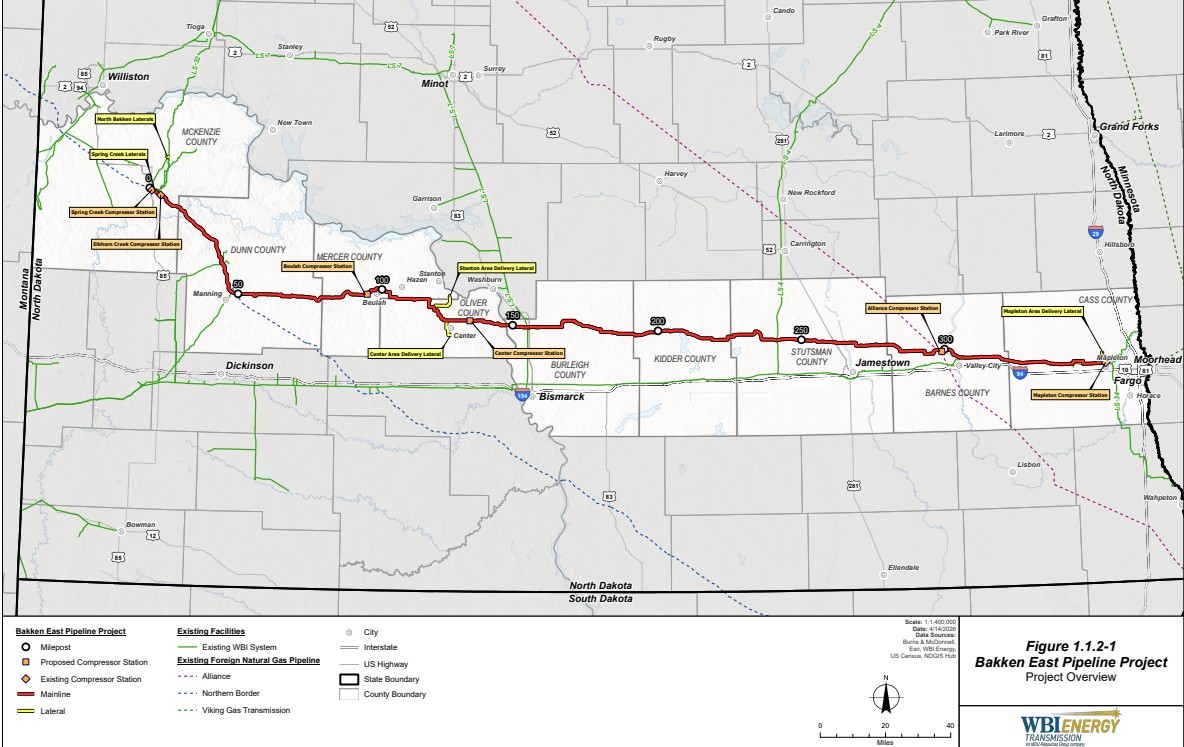
The Federal Energy Regulatory Commission is holding meetings across the state this week and the first week of June for the Bakken East Pipeline, a new 350-mile pipeline that would move gas from the Bakken Shale formation in the western part of the state to eastern North Dakota, ending near Fargo.
The pipeline, planned by WBI Energy, is eligible for up to $500 million in taxpayer-subsidized financing over 10 years under an incentive program the state’s legislature recently expanded to grow the state’s natural gas network.
Some residents are objecting to the potential seizure of their land rights through eminent domain to build the pipeline. They are also raising questions about what they say is a lack of transparency regarding the state funding agreement.
The critics include Vern Thompson, a Democratic candidate for state agricultural commissioner, who organized a May 4 press conference that featured a small group of farmers, ranchers, and local officials.
“Why are meetings held behind closed doors by government officials and industry with no participation by the general public?” asked Tim Leppert, a zoning administrator for Russell Township in LaMoure County, at the press conference.
While a version of the state program has existed with minimal funding since 2007, the legislature significantly expanded it in 2023 and then boosted the funding again last year to $50 million annually.
The offer of hundreds of millions in public dollars is meant to sweeten the deal for energy companies to move methane, a less valuable byproduct of drilling for crude oil in the Bakken formation, to the eastern part of the state. This will help diversify natural gas supplies in communities like Fargo and Grand Forks, where the only source of natural gas is a pipeline from Canada, said Gov. Kelly Armstrong, a Republican who took office in December 2024.
“In short, we’re taking an excess energy product that’s stranded in the Bakken and moving it across the state to people who need it,” Armstrong wrote in an August 2025 op-ed. “That means a cheaper source of power and heat for homeowners and businesses in our communities as they look to grow their economies.”
The governor is one of the three members of the North Dakota Industrial Commission, along with the state’s attorney general and agriculture secretary. The three voted to approve the deal after a closed-door meeting with WBI Energy representatives. The commission has not released the exact terms of the financing deal, according to the North Dakota Monitor.
Some landowners along the route are pushing back against the project.
Mike Berg, a farmer in Oliver and Mercer counties, said the Bakken East route would cross his land and could end up forcing him to sell access to his property for the pipeline right-of-way via eminent domain. He also discussed a nearby data center in Mercer County planned by Basin Electric Power Cooperative and wind energy company NextEra. The county recently passed a one-year moratorium on data centers.
“This is not about stopping progress,” Berg said. “It’s about balance, it’s about fairness. … When did my private property rights take a backseat to outside corporations?”
Wes Klein, a Mercer County rancher who formerly worked for Basin Electric Power Cooperative, a power utility co-op, pointed out WBI Energy’s history of using eminent domain to force farmers and ranchers to accept pipeline easements on their land in the Bakken region.
“People need to get ready across the state because if WBI comes to them, if they say no, they’re going to say … we will use eminent domain,” Klein said.
In a letter to federal regulators, the company said it is evaluating whether to seek a shortened environmental review under the National Environmental Policy Act, something the Trump Administration and Republicans made available in the "One Big Beautiful Bill Act," enacted in July 2025.
The project could also qualify for a faster review under Trump's executive order declaring a national energy "emergency," even though the U.S. has broken energy production records for four years in a row.
The pipeline is meant to help with a bottleneck of natural gas flow related to North Dakota’s aggressive anti-flaring rule. In oilfields without a natural gas pipeline network, operators sometimes release the associated gas that flows up alongside oil to the atmosphere, causing vast amounts of greenhouse gas pollution. A preferred alternative is burning that gas off in a flare, which reduces greenhouse gas pollution but releases health-harming combustion byproducts that form smog and soot.
About two-thirds of the natural gas produced from the Bakken flows up in oil wells alongside petroleum. As Bakken oil wells age, the share of gas compared to oil in the wells’ production tends to increase. The average gas-to-oil ratio in the region has been rising, setting a new record in September 2025.
North Dakota banned the venting of natural gas in 2014 but allows companies to flare gas for the first year of a well’s life before putting it to use or capturing and selling it. Continued flaring after the first year makes the operator liable for state taxes and royalties on the wasted gas.
The rule has helped reduce the amount of gas vented and flared from a high of 205 billion cubic feet in 2019 to 67 million cubic feet in 2024, according to the U.S. Energy Information Administration. About 96 percent of the natural gas produced in the state is captured instead of vented or flared, according to state officials.
If there is not enough pipeline space to capture the gas, oil operators often choose to curtail oil production to avoid running afoul of the flaring rules. This reduces funding to the state, where oil and gas extraction taxes made up 14 percent of the state’s revenues in 2021 – more than any other state, according to the Tax Policy Center.
The construction of the Bakken East project means “oil producers can maintain and increase their output, versus having to curtail production to stay within state goals for reducing the flaring of natural gas at the wellhead,” Armstrong, the state’s governor, wrote in his August 2025 op-ed.
Thompson, the agriculture commissioner candidate, operates a trucking company hauling natural gas liquids in the oil patch and said he supports the idea of a pipeline moving natural gas from western to eastern North Dakota. The state’s anti-flaring rule has allowed his company to harvest and sell liquid forms of natural gas – ethane, propane, and butane, for example – to Canada, where they are blended with heavy tar sands oil.
“I feel good about what we’ve been doing because it’s not being flared off,” Thompson said. “I feel good about a pipeline, the concept, because [the gas is] not being flared off.”
But Thompson said he has questions about the specifics of this project, including whether WBI Energy will be eligible for other financial incentives and how much of the gas is meant for consumers and small businesses versus being dedicated to data centers.
“It’s your money, you should be able to know,” Thompson said of the financing deal.